
Crenshaw County Scheduled vs Actual
A scheduled release date is a planned or computed date. An actual release date is the date the person left custody or moved to the next legal status. In Alabama ADOC records, the most important scheduled-date field is not labeled as a generic projection. ADOC calls it "Minimum Release Date" and defines it as the earliest scheduled date an inmate can be released to probation or end of sentence. That date can change.
Crenshaw County Jail timing is different. A local pretrial detainee may leave jail after bond is posted, after a judge issues a release order, after dismissal, after time served, or after transfer. That person may not have any projected release date in ADOC because ADOC is for state prison custody. For a local release, use the jail release record and Crenshaw County court docket. For a state prisoner, use ADOC and the Bureau of Pardons and Paroles.
Find Crenshaw County Release Date
The release-date search should start with the system that holds the person now. A county jail record answers whether a person is still at Crenshaw County Jail, released, bonded out, transferred, or held for another agency. ADOC answers current state-prison custody. The Bureau answers parole hearings, parole grants, mandatory release, and supervision questions. The court clerk answers case action, sentence, probation, and jail-credit issues.
- Decide whether the person is in Crenshaw County Jail, ADOC custody, federal custody, ICE custody, or post-release supervision. Do not assume a jail release means a community release.
- For a local jail case, contact the jail or sheriff records channel and ask for the public booking and release record. The official Crenshaw County sheriff listing is the local starting point. Use Crenshaw County released inmates for the full named-person path.
- For a sentenced state prisoner, search the ADOC inmate search by AIS number when available, or by first and last name. ADOC states the AIS field takes precedence over name searches.
- Review ADOC fields for Minimum Release Date, Jail Credit, Good Time Received, Good Time Revoked, Parole Consideration Date, Parole Status, sentence term, offense, and time served.
- Check the Crenshaw County Circuit Clerk path if jail credit, sentence wording, probation, or a new court order may have changed the date.
- Use the scheduled parole hearings page and hearing results archive if parole consideration affects the date.
- Register through Alabama VNS or VINELink Alabama for covered ADOC-sentenced custody notifications, then confirm final release with the agency record.
The ADOC public search is shown in this captured source from the Alabama Department of Corrections inmate search.
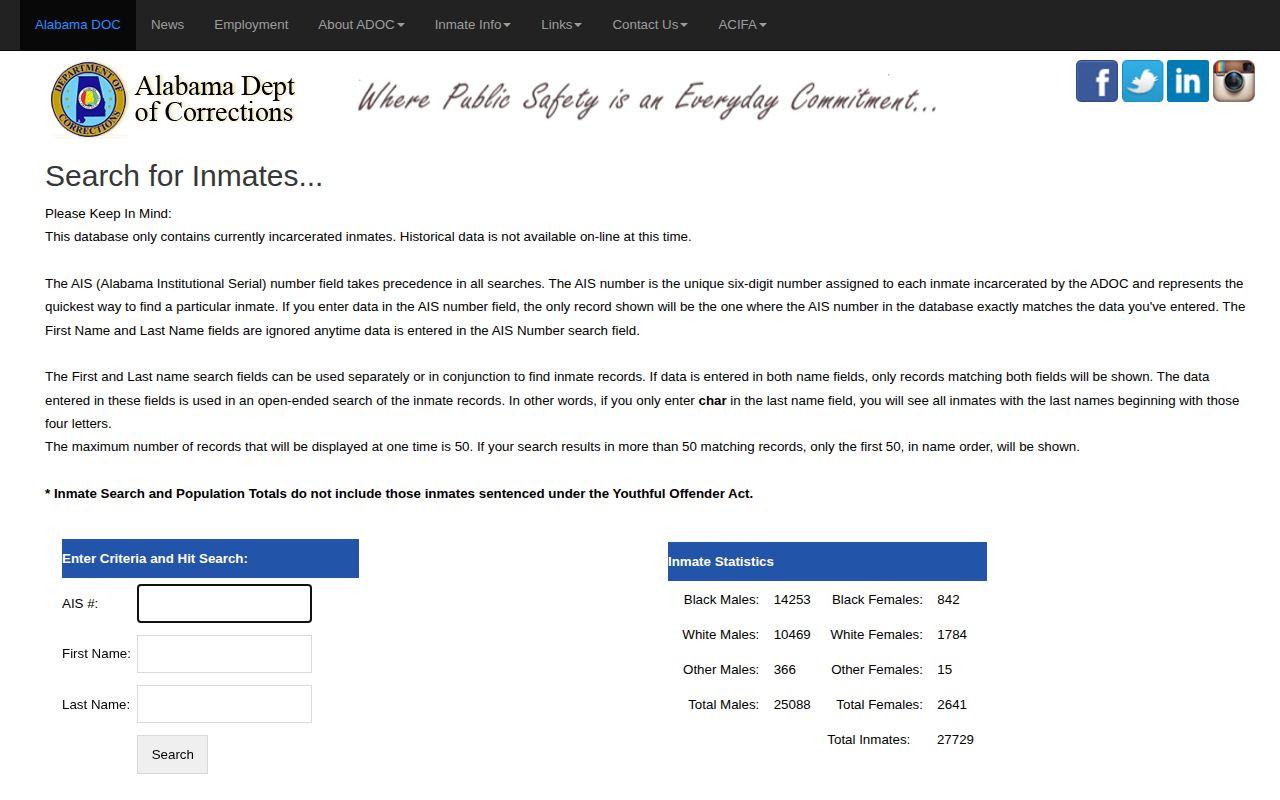
The search is useful while the person is currently incarcerated, but ADOC warns that historical data is not available online.
ADOC Minimum Release Date
ADOC's field is "Minimum Release Date," not a generic projected-date label. The definition is tied to the earliest scheduled date for release to probation or end of sentence. ADOC also warns that the date can change because of disciplinaries that take away good time, new cases received from the circuit clerk, or changes to the current sentence. That warning should stop anyone from treating a single screenshot as the final release proof.
| ADOC field | Why it matters for Crenshaw County |
|---|---|
| AIS number | The six-digit Alabama Institutional Serial number. ADOC says it controls the search when entered. |
| First name / last name | Useful when AIS is unknown. ADOC name search can return broad matches. |
| Minimum Release Date | The earliest scheduled release to probation or end of sentence, subject to change. |
| Jail Credit | Time credited from county jail before sentence. ADOC says the sentencing county circuit clerk prepares it. |
| Good Time Received / Revoked | Credits earned and credits removed through discipline. These fields can move the release date. |
| Parole Consideration Date | A tentative Board date, not a promise of release. |
The field definitions are shown in this captured source from ADOC definitions.
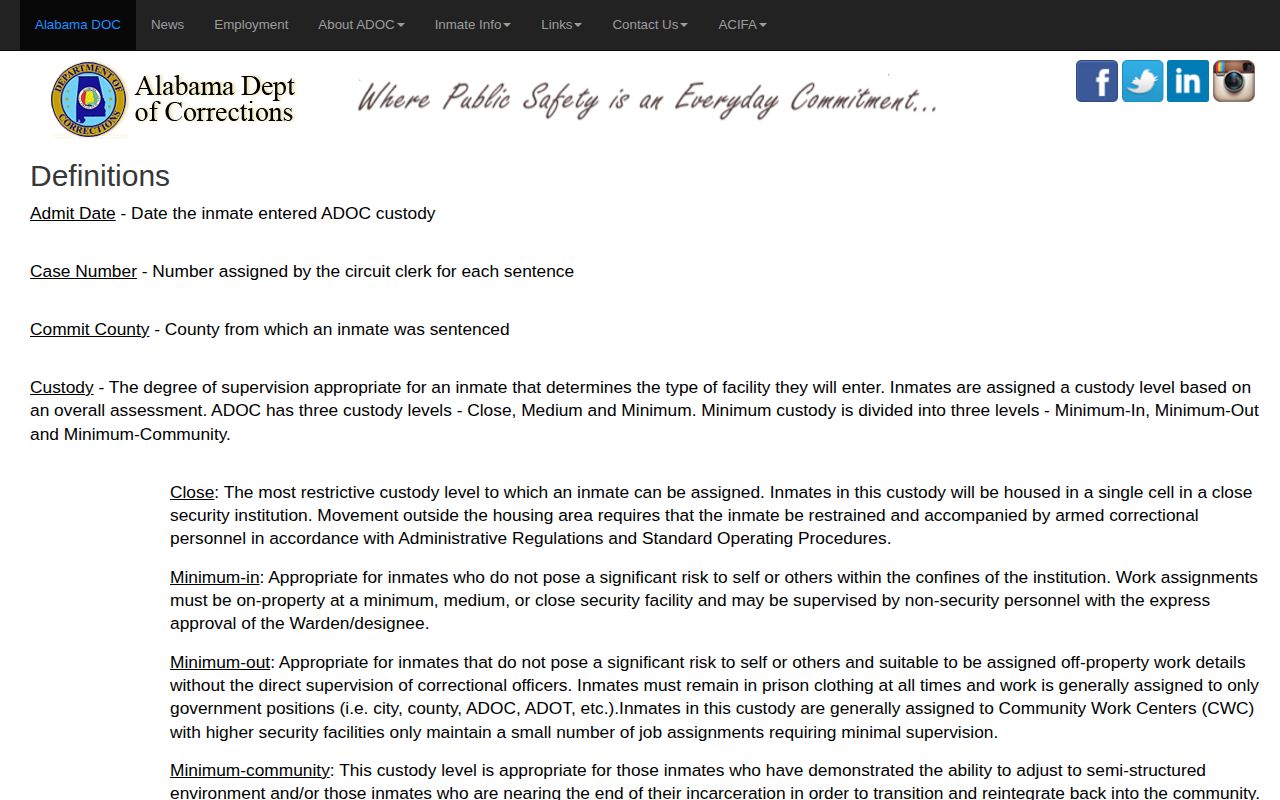
Use the definitions to read the record correctly before calling a date final.
Crenshaw County ADOC Limits
The common false negative comes from ADOC's current-custody limit. ADOC says its public inmate database contains currently incarcerated inmates and that historical data is not available online. A person who has discharged from ADOC may no longer be found through that public search. That absence is not the same as proof that the person was never in custody, never released, or has no record.
When ADOC search does not return a result, move to the next official channel. Check the Crenshaw County court record for sentence and jail credit. Use ADOC public records for prison records not available online. Check Bureau hearing results if parole is involved. Use Alabama VNS for covered notification history where it applies. For a person who left county jail without an ADOC sentence, return to the jail release record and the court docket rather than forcing the ADOC search to answer a local question.
Good Time and Jail Credit
Good-time fields help explain why two people with similar sentences can have different release dates. ADOC defines Good Time Received as the amount of good time an inmate has received. It defines Good Time Revoked as the amount of good time removed as disciplinary action. A disciplinary loss can push the Minimum Release Date later. Earned credit can move the date sooner, subject to sentence type and legal limits.
Jail Credit is especially local. ADOC defines it as time spent in county jail before sentencing and says the sentencing county's circuit clerk prepares that time. For a Crenshaw County conviction, jail-credit questions point to the Crenshaw County Circuit Clerk and the court record. The arrest date, booking date, and sentence date can help identify the issue, but the official credit is not guessed from those dates alone.
Alabama public-records access also has a records route. ADOC Administrative Regulation 023 says public records requests must be submitted in writing on properly completed Form 023-A to the Public Records Coordinator, and ADOC Form 023-A lists a non-refundable $20 processing fee. That is an ADOC records fee, not a Crenshaw County jail fee.
Alabama Parole Date Rules
A parole consideration date is not the same as a release date. ADOC defines it as the tentative date set by the Parole Board. The Alabama eligibility rule in Ala. Code Section 15-22-28 sets initial parole consideration dates. For prisoners convicted on or after March 21, 2001, of certain listed Class A felonies, the initial date follows completion of 85 percent of the total sentence or 15 years, whichever is less. For other prisoners, it follows one-third of the sentence or 10 years, whichever is less.
The listed Class A felony rule includes first-degree rape, first-degree kidnapping, murder, attempted murder, first-degree sodomy, sexual torture, first-degree robbery with serious physical injury, first-degree burglary with serious physical injury, and first-degree arson with serious physical injury. That list affects the first parole consideration date. It does not guarantee release at 85 percent, and it does not replace the Board's hearing result or ADOC's custody record.
Mandatory release adds another Alabama-specific layer. The Bureau FAQ says Ala. Code Section 15-22-26.2 mandatory release applies to eligible inmates with offenses committed on or after January 30, 2016, excludes certain child sex offenses and life sentences, and uses sentence-length ranges before the end of sentence. A mandatory release can create a supervision period before the sentence's final end date.
Why Release Dates Change
A Crenshaw County projected release date should be treated as a live status point, not a static promise. ADOC, the court, the Bureau, and other agencies can each affect timing. The table below keeps the source of each change clear.
| Change factor | What can happen | Where to verify |
|---|---|---|
| Good-time revocation | Discipline removes credit and can move the date later. | ADOC definitions, ADOC record, ADOC records request |
| New cases or sentence change | New court information changes the current sentence or date calculation. | Crenshaw County Circuit Clerk, Alacourt, ADOC record |
| Jail-credit correction | County jail time before sentencing may be corrected or disputed. | Sentencing county circuit clerk |
| Consecutive sentences | One sentence may run after another, affecting parole timing and release. | Court sentence, ADOC sentence fields, Section 15-22-28 |
| Holds or detainers | Another county, federal agency, or ICE may receive custody after local release. | Jail release record, receiving agency, BOP or ICE when applicable |
| Parole action | Grant, denial, continuation, revocation, or delinquency changes status. | Bureau hearing schedule, results archive, Public Information Unit |
| Court order or appeal | Resentencing, probation revocation, appeal, or dismissal can change custody. | Crenshaw County court record |
Crenshaw County Jail Timing
A person in Crenshaw County Jail on a pretrial case usually does not have a projected release date in the same way a state prisoner does. The key events are bond, court order, dismissal, plea, sentence, time served, probation, hold, or transfer. If the person has a bond release, the case can continue in court after the jail release. If the person is transferred to ADOC, the county jail release is only the move out of local custody.
The practical path is to ask for the public booking and release record, then compare it with the court docket through the Crenshaw County court access point. The record should identify the release date and, when available, release time, release reason, bond or court-order notation, holds, transfer notation, booking number, and court case number. When the release reason is brief, the court record explains the order or disposition that caused it.
Note: A local jail release can be a transfer, so verify the receiving agency before assuming the person is free in the community.
Confirm Crenshaw County Release
Final confirmation should come from the agency that controls the record. For a local jail release, that means the Crenshaw County Jail or sheriff records channel, plus the court if a judge's order caused the release. For state custody, use ADOC current search while the person is incarcerated, ADOC public records when online data is not enough, and Bureau sources for parole or mandatory release. For notification, use the VINELink check path only where Alabama VNS coverage applies.
Federal and immigration custody require different systems. A Crenshaw County release entry may show a hold for U.S. Marshals or ICE. That is not an ADOC projected release date and not a local street release. Use BOP for federal sentenced custody and ICE locator channels when the release record points to immigration custody.
The safest release-date answer is a matched set of records: jail or ADOC custody status, court sentence or order, parole or mandatory-release status if applicable, and a final release or transfer record from the source office.