
Crenshaw County Parole vs Probation
Parole and probation both describe supervision outside a jail or prison, but they come from different points in a case. A person released from Crenshaw County Jail may be placed on probation by the Crenshaw County District or Circuit Court. That path is tied to the case docket, sentencing order, suspended sentence, revocation order, or warrant record. A person sentenced to ADOC custody may later be considered for parole by the Alabama Board of Pardons and Paroles, released under mandatory release, or discharged at the end of the sentence. The Alabama Bureau of Pardons and Paroles is the state agency for parole and probation supervision.
The key verification point is custody type. If the person bonded out before trial, a parole hearing page will not explain that release. If the person was sentenced to state prison, the court record explains the sentence, ADOC tracks custody while current, and the Bureau handles parole hearings, parole status, and revocation-related public questions.
| Supervision type | Where it starts | How to verify it | What it may show |
|---|---|---|---|
| Probation | Crenshaw County court sentence or order | Crenshaw County Circuit Clerk, Alacourt, supervising probation office | Probation term, revocation, warrant, sentence change, discharge |
| Parole | ADOC sentence and Board decision | Scheduled hearing, hearing result, Bureau Public Information Unit | Granted, denied, continued, revoked, delinquent, discharge status |
| Mandatory release | Eligible ADOC sentence near its end | Bureau FAQ, ADOC record, supervising agency | Release to supervision before the final sentence end date |
- Parole
- Release from prison supervision after Board action or a related state release process.
- Probation
- Court-ordered supervision, often instead of serving all time in jail or prison.
- Discharge
- The end of custody or supervision when the sentence or supervision term is complete.
- Delinquent or revoked
- A supervision status showing the person may have violated conditions or lost release status.
Verify Crenshaw County Supervision
A Crenshaw County parole and probation check works best as an ordered verification path. Start with the local case if the person left Crenshaw County Jail. Move to ADOC and the Bureau only when the case involved a state prison sentence, parole consideration, mandatory release, or state supervision. Alabama VNS and VINELink can help with covered ADOC-sentenced offenders, but the Alabama VNS coverage note points pretrial county cases back to the sheriff in the county where the case occurred.
- Identify whether the person was released from Crenshaw County Jail, sentenced to ADOC, or moved to another agency. For the local custody channel, start with the official Crenshaw County sheriff listing. A jail release can be a bond release, court order, sentence completion, transfer, or hold release.
- Check the Crenshaw County court record for probation, sentencing, revocation, warrant, or discharge entries. The clerk page says the circuit clerk keeps District and Circuit Court records and points users to Alacourt / Just One Look.
- Use the ADOC inmate search only for current ADOC custody. ADOC states that historical data is not available online, so an absent result is not a complete release record.
- Check scheduled parole hearings if the person is waiting on Board action. Use the hearing results archive for grant, denial, continuation, or cancellation context.
- Contact the Bureau Public Information Unit when the issue is parole eligibility, hearing dates, hearing results, or a person granted parole but not yet released.
- Use Alabama VNS or VINELink Alabama when the person is a covered ADOC-sentenced offender and a custody-change notification is needed.
For a broader named-person release search, the county release record and court record remain the base path through Crenshaw County released inmates. Supervision records add another layer after the release has occurred.
Alabama Supervision Contact
The official statewide contact found for public parole questions is the Bureau Public Information Unit. The unit handles general public questions about parole eligibility, consideration dates, hearing dates, hearing results, and questions about an inmate who has been granted parole but not yet released. That last category matters in Crenshaw County because a hearing result can show a grant before the person physically leaves ADOC custody.
Alabama Bureau of Pardons and Paroles
Public Information Unit
301 S. Ripley Street
Montgomery, AL
334-242-8700
Use option 2 for upcoming hearing questions and option 3 for granted-but-not-yet-released questions.
Crenshaw County Circuit Clerk
29 S. Glenwood Avenue, Suite 206
Luverne, AL 36049
334-335-6575
Records office hours are listed as Monday-Friday, 8:30 a.m. to 4:30 p.m.
The court contact is listed here because probation often appears first as a court disposition, not as a parole hearing. If the case ended in a suspended sentence, probation order, revocation, or warrant recall, the court record is the public path for the event that caused the release or supervision change.
Crenshaw County Parole Hearings
For ADOC-sentenced prisoners from Crenshaw County, parole hearings are handled by the Alabama Board of Pardons and Paroles through the Bureau. Scheduled hearings, cancellations, and results are separate pages. A scheduled hearing is not a release date. It is the date the Board is expected to consider the case, unless it is continued, canceled, or otherwise moved.
The Bureau's results archive is a useful official source because each post reports a hearing date and the number of cases granted, denied, or continued. The archive does not replace the court sentence or ADOC custody record, but it can explain why a person remains incarcerated after a hearing or why a grant still needs release processing. A granted result can still require conditions, processing, and confirmation through the Bureau or ADOC before the person leaves custody.
The parole results archive is shown in this captured source from the Alabama Bureau hearing-results archive.
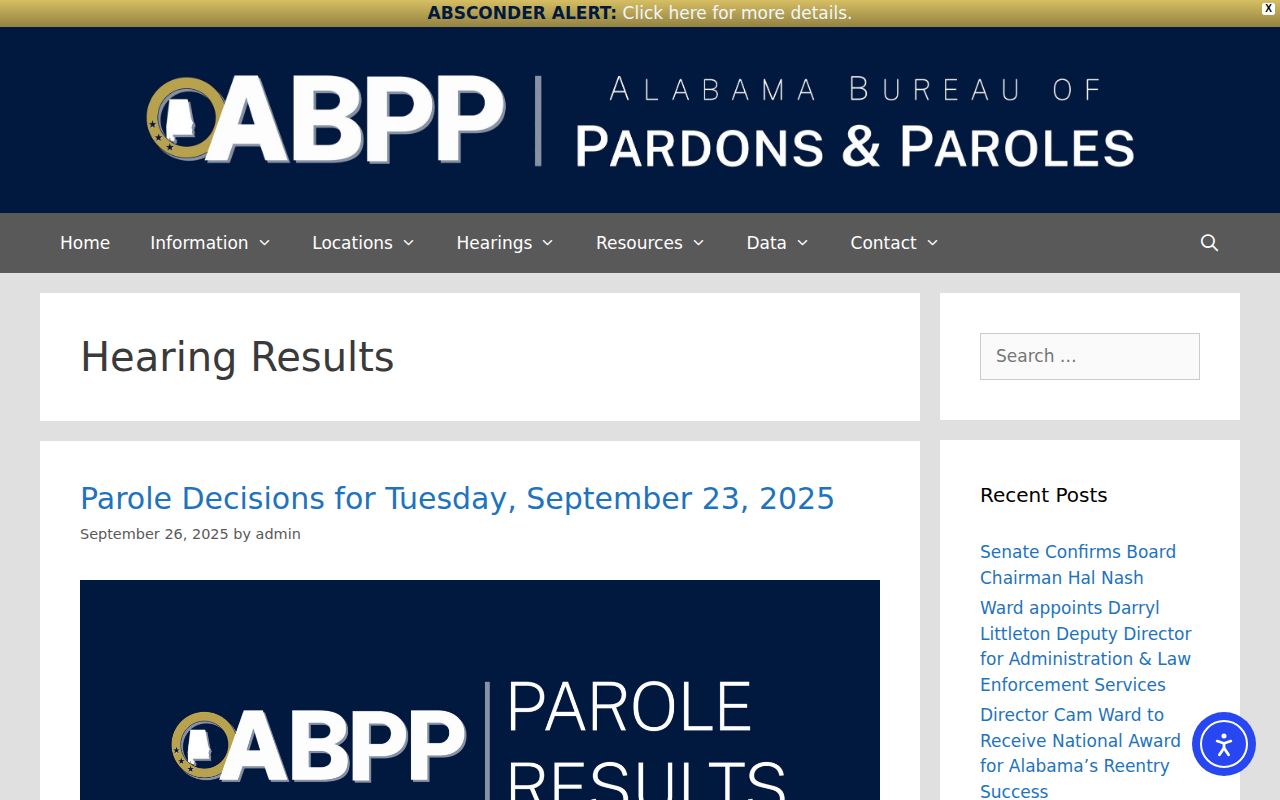
Use the archive to read the Board outcome, then use the Bureau Public Information Unit when the question is whether a granted parole has turned into a physical release.
Delinquent Revoked Supervision Status
Supervision status can change after release. ADOC defines parole status in terms that include on parole, delinquent, or revoked. A delinquent status generally means the person is not in good standing with supervision. A revoked status means parole has been taken back through the revocation process. The Bureau Public Information Unit page also references communication with the Revocation Unit for public questions.
For Crenshaw County, do not treat a missing jail roster entry as proof that supervision is clear. The person may have left jail and then faced a probation revocation, parole delinquency, warrant, hold, or new court order. The sheriff or court can address county warrants and court actions. The Bureau channel is the better route for state parole revocation and delinquency questions.
Mandatory Release in Alabama
Mandatory release is not the same thing as discretionary parole. The Bureau FAQ discusses Ala. Code Section 15-22-26.2 for eligible inmates with offenses committed on or after January 30, 2016. It excludes people convicted of a sex offense involving a child and people serving life sentences, and it uses sentence-length ranges before the end of sentence. In practical terms, mandatory release can place a person under supervision before the sentence's final end date.
This distinction matters for Crenshaw County release records because a family member may hear that someone was released before the end of sentence. The more precise question is whether the person reached a minimum release date, received parole, was placed on mandatory release, completed the sentence, or was discharged. The ADOC record, Bureau FAQ, and supervision contact provide the state-level answer. The court record still explains the Crenshaw County conviction and sentence.
Crenshaw County Record Corrections
A release date, jail credit, case disposition, or sentence detail can look wrong when different systems update at different times. ADOC says Jail Credit is prepared by the sentencing county circuit clerk. ADOC also says Minimum Release Date can change when the circuit clerk sends new cases or sentence changes. For a Crenshaw County conviction, that means the Circuit Clerk and Alacourt record are central when the issue is jail credit or court-sent sentence data.
For parole and probation, a correction path should follow the record source. Court terms, probation orders, and warrants belong with the court. ADOC sentence fields and custody fields belong with ADOC. Parole eligibility, hearing dates, hearing results, and granted-but-not-released questions belong with the Bureau. Old unofficial jail pages should not be treated as the controlling source when an official court or agency record says something different.
Note: Ask the agency that owns the record to correct the record; do not ask a different office to override it.
Crenshaw County Supervision Discharge
Supervision ends by discharge, sentence completion, court order, or another official action. A discharge is not the same as a jail release. It means the custody or supervision obligation has ended for that record. In a probation case, the discharge may be reflected in the court docket or probation record. In a parole case, it may be reflected through the Bureau or ADOC-related records.
Public access still has limits. Alabama public-records law, Ala. Code Section 36-12-40, provides a general right for residents to inspect and copy public records, but that rule is subject to other law. Juvenile, youthful-offender, sealed, expunged, security, medical, and active-investigation limits can affect what an office releases. A narrow request for the public supervision or release status, tied to the correct person and case, is stronger than a broad request for every file about a person.